Sujoy Mukhopadhyay is professor of geochemistry and cosmochemistry at the University of California, Davis. In discussion with Times Evoke, he explains how Earth’s Crust— and its deep interior — mould life on our planet. We present a summary on his explanation of how the outgassing and recycling of volatiles helps shape surface habitability:
Dr. Mukhopadyay studies how planets form, the creation of the early atmosphere and the degassing or release of volatiles like carbon dioxide(CO2), hydrogen and sulphur dioxide from planetary interiors. In this process, noble gases are key, according to him. Carbon dioxide, nitrogen, hydrogen, etc., are chemically reactive but the inert nature of noble gases gives them an advantage in allowing these to keep a record of early events as no chemical reactions or biology alters them. Among these, and especially among the heavier noble gases like krypton or xenon, some have many different isotopes which belong to the same element but have different numbers of neutrons. Some of these isotopes are produced by radioactive decay while some are non-radiogenic or not produced by radioactivity. The non-radiogenic isotopes allow researchers to look at different sources of volatiles on Earth while the others hold information on timespans and decay. They act as tracers of how fast things might be happening. They are the culmination of figuring out where gases are coming from — and the rate at which a planet is forming.
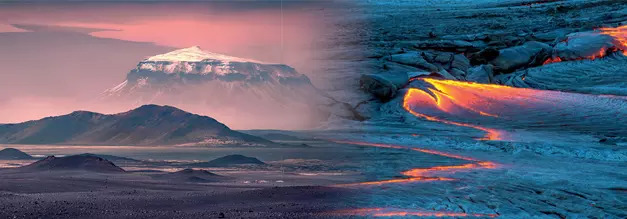
BOTH STATIS & FLOW: Lavas (R) found in volcanic regions like Iceland’ s Odadahraun highlands (L) bring materials up from Earth’ s interior to the surface — these include noble gases which bear unalterable evidence of planetary processes, their inert nature resisting any changes.
Some noble gases are also located in the planet’s interior, typically trapped in the crystal lattices of minerals. For Earth, we can sample the atmosphere quite easily — for the interior, researchers need to rely on lavas or melts which come up to Earth’s surface, bringing gases with them. When they solidify, these melts trap bubbles inside them — noble gases are often found in these tiny bubbles. Researchers study these by crushing samples apart in the laboratory and doing measurements using mass spectrometers. For other planetary materials like asteroids or meteorites, we often find gases trapped in the crystal lattices of minerals present there — heating techniques are used to release those and mass spectrometers to measure them. Xenon is a noble gas — it has nine separate isotopes. Of these, many are produced by the radioactive decay of three separate groups of elements, uranium, plutonium and iodine. Uranium is still around in the solar system and on Earth. Naturally occurring plutonium was present in the early solar system and Earth but has become extinct now, having all decayed away. The same is true of radioactive iodine, which was in the early solar system and our early planet — but which hasn’t completely decayed yet. These different processes and their diverse timescales allow researchers to look at the history of planet formation. Examining a certain isotope tells us this had to have been produced maybe in the first 100 million years of Earth’s existence — it couldn’t have come later on. That puts a firm timestamp on when a certain process, like a melting event or the formation of the moon, might have happened.

LUMINOUS: Isotopes indicate the moon’s age.
Researchers try to address how the rates of volatile exchange have changed through time — this includes noble gases, water, CO2 and nitrogen. Water and CO2 play a vital role in making a planet surface habitable — researchers now know that CO2 is very important in producing the greenhouse effect, too much of it is harmful while too little also makes a planet uninhabitable. We look at how much interior degassing rates have changed as Earth’s interior cooled and how much of these gases were recycled back through time. If there were no recycling, we can expect that the surface inventory of these gases will keep growing through time. The balance between the outgassing and recycling of volatiles is important in keeping Earth’s surface habitable.
Some vital aspects of Earth’s evolution start with the differentiation of the interior into the core and mantle as Earth was forming — a critical aspect is the formation of Earth’s crust. It is an open question as to how much of the crust formed as a function of time. One hypothesis says it formed very early — but was this early crust submerged under water? And when did most of it then emerge? The answers are important to understand the evolution of life.

Even today, Earth is evolving because this differentiation is an ongoing process — currently, Earth’s interior is partially melting at mid-oceanic ridges where tectonic plates form and move apart. We have hotspots like Hawaii and the Galapagos where we can see the products of interior melting coming up. Subduction zones with these tectonic plates start going back, recycling some of these materials into the interior, also creating new continental crust.
Many of us think of climate change as something that happens in Earth’s atmosphere. But Earth’s interior is key in this context too. As the atmospheric composition changes — there’s a short-term carbon cycle that affects the amount of CO2 in the atmosphere. There, Earth’s oceans play a very important role. Carbon exchange between the atmosphere and oceans control how much CO2 can be present in the atmosphere over a short timescale, covering around 1,000 to 10,000 years.
Earth’s interior affects how much potential CO2 there might be because of outgassing from the interior and recycling. our impact has been to change atmospheric CO2 in an incredibly short time. Yet, Earth’s interior and crust are central in affecting the long-term composition of the atmosphere, relevant over millions of years. This long-term interaction is what makes a planet habitable in the first place — the shorter-term cycles, where the ocean and biosphere come into play, then affect the amount of CO2 in the atmosphere as well. So, different cycles and entities impact the atmospheric composition that enables life.
https://timesofindia.indiatimes.com/times-evoke/pdf – The content from 18th November 2023 has been summarized as a blog entry
https://timesofindia.indiatimes.com/times-evoke/photo/105304563.cms The second article at the link has been summarized in this blog
Discover more from rasayANix
Subscribe to get the latest posts sent to your email.
 rasayANix