Timothy D. Herbert is professor of earth, environmental and planetary sciences at Brown University. Speaking with Srijana Mitra Das at Times Evoke, he discusses sea sediments; illuminating how Earth works. According to him the sediments contain Earth’s archive. A summary of the discussion is provided in this blog post:
On the core of his research?
Prof Herbert is interested in Earth’s climate past to get lessons for the future — these don’t necessarily apply to what we experience tomorrow but where we are going over the coming decades and centuries. His work especially includes clues taken from the deep sea that tell the global community about changes in the temperature of the ocean and its ecology over time. The effort is to link those to the extent of sea level in the past as ice sheets grew and melted, how eco systems of planktonic organisms, the base of the food chain in the ocean, responded to major changes in Earth’s climate and the underlying question of how much carbon dioxide (CO2) levels in the past controlled the planet’s temperature — this is the existential question the global community has today.
On how do oceans impact life on land? –
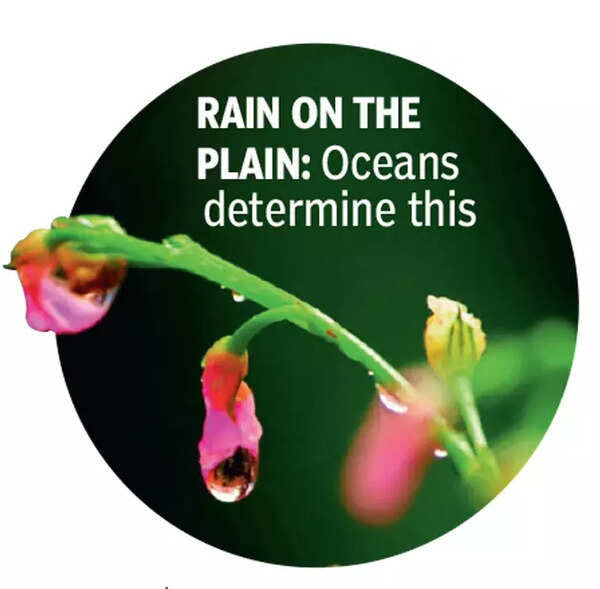
Prof. Herbert thinks of the ocean’s role in an economic analogy. The ocean is the world’s biggest bank account of heat — the atmosphere heats and cools very quickly and the land surface also does so rapidly (if a little bit slower than the atmosphere). So, in analogy with an economy that has complex movements of money, the climate system is always moving energy, water, heat and other important amounts around — the ocean is the major reservoir. The resources we need on land, like drinking water, etc., are directly determined by the temperature of the ocean as that water started its journey especially in warm areas of the sea where most evaporation into the atmosphere begins. This travels across the globe and comes as rain to land. So, the lives on land are very dependent for some thing as critical as freshwater on the ocean’s temperature.
On what clues does the study of oceanic sediments offer? –
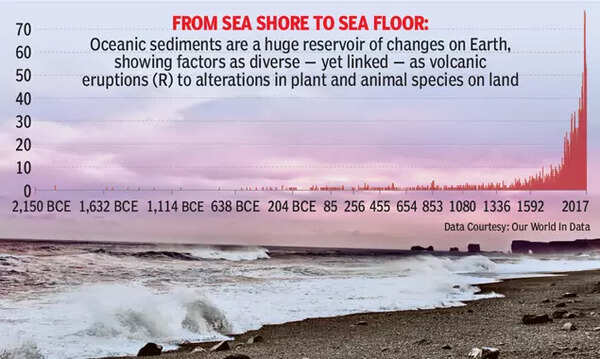
Everything at the bottom of the ocean began at its top, from plankton which perished and fell down to volcanic debris, dust, etc. The deep ocean is thus an archive of everything from the past. Its sediment layers contain an incredible richness of clues — they have fossil evidence of organisms living before, telling the global community something of their ecology thus. They contain chemical clues — in Prof Herbert’s laboratory, the research is on biomolecules made by certain marine algae. By studying sediment cores, it is possible to quite accurately reconstruct changes in the ocean.
On Prof. Herbert’s research on the late Miocene global cooling phenomenon and how this shaped modern ecosystems? –
A student of his working in Italy happened to collect sand samples from million years ago. On running those in the laboratory — the results showed very warm temperatures back at that time. Oceans were more than 10 degrees Celsius warmer than the region is today. That’s a lot of change. So, the question was to know if Earth was indeed that much warmer then — through the literature, measurements and studying multiple spots in the ocean, it was confirmed that Earth was much warmer in the middle Miocene, 12 to 15 million years ago. It then began to cool dramatically everywhere — simultaneously, there were profound changes on land which precisely correlated with changing ocean temperatures. About seven million years ago, forested areas in Africa and southern Asia moved to savannas with much less forest as the climate cooled. It got dryer on land. So, it could be seen how Earth was experiencing linked changes between what caused the cooling of the ocean and rainfall and ecology on land, — where deserts or scrubland are seen now were once rich forests.

NOT JUST DESERTS: Forests existed here.
On how ancient sea sediments are studied? –
Since species appeared and then went extinct, we can figure out approximately, the time of those biological patterns. Palaeontologists, who look at the fossil records give a preliminary idea of how old a sediment is. Importantly, these aren’t yearly layers but are made by regular changes in Earth’s orbit that happened every 20,000 and 41,000 years. Earth’s orbit wobbles predictably — these small movements leave a signal in things we can measure in sediments, like temperature, composition, etc., for example, the minerals of a sediment changing. Because of astronomers, we can count these cycles back in time and put our finger on a sediment, say, five or six million years old, to know its age up to within a few thousand years.

FROZEN IN TIME: Sediments show Ice Ages.
Drawing from such paleoceanography, what can be understood about current climate change? –
The lesson learnt which is essential for our present and future is how connected different aspects of Earth’s climate are. Today focus quite rightly, is on the increasing heat of the planet — but what can be called as feedbacks or connections, which can be seen working over millions of years past, are also critical. One link is how fast polar ice caps melt as Earth warms and then how sea levels rise. Another is changes in ecosystems — plants and animals are shaped by their climate and the past gives evidence on how forests, grasslands and species altered their distribution or abundance; as climate changed. Temperature is extremely important but there are many other ways these climate connections will be impactful, for the future.
On the most interesting sediments that he has researched? –
Prof Herbert is currently working on sediments which are 130 million years old, preserved in uplifted strata in Italy. These used to be far under the ocean but because of tectonic movements, namely Italy crashing into Europe and uplifting mountain belts, they came up on land. such layers would show regular changes in climate through orbital alterations — but by digitally measuring these and putting them through statistical tests, we found these do become very evident, showing repeating patterns in Earth’s history, of warm and cold, wet and dry, biological activity, etc. By studying these, we can start to understand the connections of how one process links to another.
The second source link goes to two discussions, the first one is being summarized as this blog entry
https://timesofindia.indiatimes.com/times-evoke/photo/105304563.cms
Discover more from rasayANix
Subscribe to get the latest posts sent to your email.
 rasayANix