
Summary – Here, we are presenting a discussion that Dr. K Ullas Karanth, a wildlife conservationist and ecologist; had with Srijana Mitra Das at Times Evoke. Dr. Karanth has discussed the past and future of National Parks in India. He said that India’s wildlife, decimated by hunting and forest exploitation, found succour in National parks.
On, How national park areas began in India –
Two stages were involved in the late 19th century, India was seeing a massive destruction of forests. There had already been discussions about whether the colonial government should set aside some land for ecological reasons, watershed protection being one. Then came news of people clearing forests on a huge scale, raising concerns about the ability to sustain the colonial military, railways, etc., all of which drew such resources. This discourse became prominent and finally, the colonial government set aside around a quarter of the country as forest reservations. these lands were mainly in the Western Ghats, Central Provinces, parts of the Terai, etc.
About wildlife, initial concerns started being voiced around the 1920s. These came against a backdrop of hunting expeditions by royals and colonials for sport as well as bounties offered on killing tigers and other animals. Laws for animal protection were brought about and in 1936, the first national park, initially called Hailey, later named after Corbett, was established in then- Uttar Pradesh. The destruction of forests continued. Conservationists were extremely worried and in 1952, the National Wildlife Advisory Board, headed by an erstwhile royal, was formed. This created some game sanctuaries, small areas where ordinary people were barred from hunting. But there was no special staff to protect wildlife and bounties on killing animals continued. The real impetus for national parks came in the mid-1960s when conservationists like Duleep Matthai expressed grave concern at how sharply Indian wildlife was declining. The Wildlife Protection Act emerged in 1972 and Rules followed in 1974 — these recognised wildlife sanctuaries and national parks, the latter receiving the highest level of protection. Commercial forestry and all hunting were banned in these areas. In 1976, this sphere was brought under the Concurrent list, including the Centre in policy-making.
Regarding challenges that were faced in this process, Dr. Karanth said –
The law was strong but there was no force to implement it. The forest department’s mandate was also to log and earn revenue. The economy was very underdeveloped then and forest revenue played a significant role. People cooked with wood, mostly from forests, while millions of cattle had to be grazed. The dependence on forests was huge. Protecting wildlife under those circumstances was a tremendous challenge — but the forest department rose to the occasion. Many officers literally sacrificed their lives to secure India’s parks – Officers like Kailash Sankhala, Shyam Sunder, S. Deb Roy, etc. The government also stayed strong on this course and compensated states which followed wildlife protection laws.
Now, circumstances have changed. A foremost challenge today is that the area for forests has shrunk while protected areas have only marginally increased. We have around four percent land as sanctuaries and national parks. We need a bigger vision now of increasing these protected areas and safeguarding against the dilution of strong wildlife protection laws.

Regarding the challenges shared with others worldwide, Dr Karanth informed that –
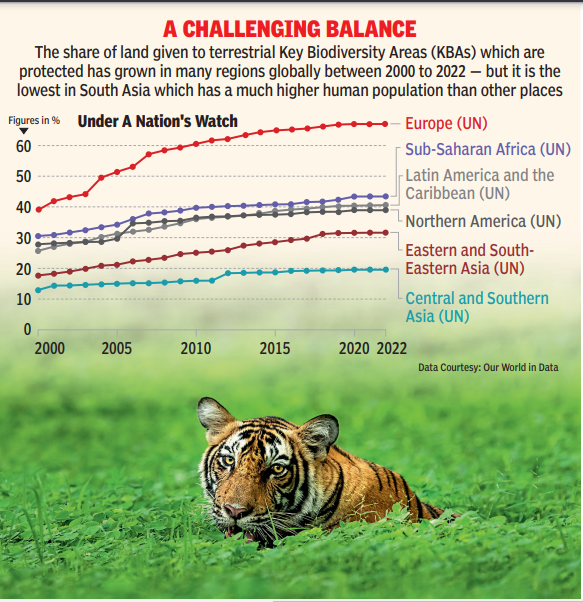
today, most tracts in the subcontinent are under cultivation but in Africa, Latin America or North America, vast expanses are still under forests. The area given for Protection is far bigger, reaching 40% of land in many places But the upside is, we have a growing economy now which is accommodating people in urban, semi-urban and periurban activities — so, the pressure to clear forests for agriculture is reducing.
On Species that have benefitted from National Parks in India, Dr . Karanth said that
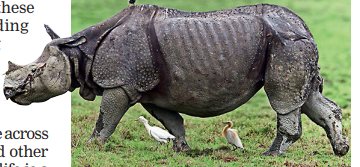
The rhinoceros is a good example. Strong government action was taken to protect the last few rhinos in Kaziranga without that, we’d have lost the species. Lions have really benefitted from the Gir forest being protected. Tigers have gained and so have a whole suite of species which share tiger habitat. Similarly, elephants benefitted as have other species associated with these charismatic beings. The brow-antlered deer of Manipur has a single population left of the whole species — this is now located in one park.
How are human communities living around national parks faring?
That is perhaps the most important challenge. Around 50 years ago, when the economic growth rate was low, most people could only rely on agriculture and animal husbandry. Those land users near national parks meant conflicts with wildlife which also eats crops and can be predators. The idea of relocating people aimed to prevent such conflicts. I’ve been involved in this process from the 1980s and it was often very hard because finding enough good-quality agricultural land to resettle people was difficult.
Today, our economy is moving from an agro-pastoral kind to one which can
support manufacturing, services and varied activities. People in biologically
rich areas are more willing to move. We could develop win-win solutions but this should be implemented by development agencies across government, conservation bodies, NGO’s and other organisations who know such areas and communities well.
Madhya Pradesh has done a good job at relocating thousands of such families
in recent years. This should be a public private partnership where the forest
department is one part of the process but not the only agency responsible for this.
Regarding what has been a memorable experience, he said that –
The most fulfilling moments came from what he could bring to the parks like
Nagarhole by way of cutting-edge science, developing new techniques for
counting tigers, using cameras and statistical models.
Discover more from rasayANix
Subscribe to get the latest posts sent to your email.
 rasayANix